1) What struck you most in the film?
 The scene in the film that the most with me, was the last scene. It was the moment after one of the shooter killed his companion, and headed to the freezer. In there he found the "most popular couple in the school". To decide which one he will kill first, he starts playing. This gives the viewer a nerve wrack. At the end we don't even know which one he killed first, or what even happened with the shooter himself. As it was an open end, the viewer is left with so many question.
2) What also impressed you?
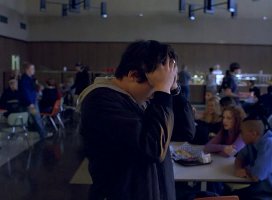
The scene were the viewer get to experience the chaos into one of the shooters head.
In deed, it was lunch time. When he finished taking notes in his notepad, the music started to be louder, the cafeteria was turning around in high speed. We could hear various voices, very different one, talking louder and louder.
I personally find that this scene is the most beautiful one in the whole movie; It was really intelligently filmed.
3) Did you find anything more particularly upsetting?
The scene that I find the most upsetting one, is the piano Scene. As the camera kept turning around, it gave me headaches.
What also made me think that this scene is quite upsetting, was how long and boring it was.
I understand that the film director wanted to show a sensitive side of the shooter, but he didn't need to make it last 5 minutes !
4) What did you find very disturbing?
What I find the most disturbing of the whole movie, is how "cold bloody" one of the killers kills his companion. He didn't even blink when he shot him. We though that something special was between them, or that they will kill themselves (as the columbine shooters), but no. he decided to kill his shooting companions in cold blood.
5) What was most shocking?
The shooters had a really easy access to guns, that is the key of the question. They first started to look for informations about to get guns though internet (which is something non-understandable). Then when the delivery guy came in, he didn't even asked them for their parents permission or their age. He just handed them the gun then left. This in a civilized world should never happen. It was really shocking to see haw easy it was for them (underaged kids) to have access to guns.
6) What does the film suggest about the two school shooters?
The film suggests that the two school shooters, were mentally disturbed. They were also put aside in the school, they were invisible. Which we can believe made their rage grow bigger and bigger.
7) What's more, what does the film director make clear about the two killers?
The film director made a really peculiar choice in the way he showed the two killers. Before committing their act, we get to see a poetic, and artistic side of one of them, who plays the piano and draws a lot. Whereas the other one, from the beginning we see that he likes violence, as he plays a shooting video game, where he shoots his victims from the back (like in the real shooting).
But before discovering all of that, Alex and Eric (the two shooters) are bullied at school, by "jock" (It is a stereotype of athletes). So one of these jocks diverts a teacher, to throw a spitball at Alex during science class. This
8) What kind of approach to the school shooting itself did Gus Van Sant opt for?
Gus Van Sant wanted to show how every student had their own hobbies, and hopes for their future. Every single one of them (event though they were different) had plans and loved ones. We have the view point of every victim. We had a privileged look into (sadly) their last day. The way Elephant was shot, allows the viewers the freedom to follow, without having a point of view imposed on them.
9) Moreover, what's the main consequence of the realistic treatment he uses? What about the 'poetic' touches he instills throughout the film?
Gus Van Sant give a realistic treatment of what happened, while at the same time instilling a poetic touches. The poetic touche caused a lot of confusion when it first aired. It renews a lot of rumors about the actual Columbine. Mainly about the Columbine shooter's sexuality (referring to the gay shower scene between the shooters pre-assault).
Filmed in long travelling shots, Elephant lets us into the lives of half a dozen of students in what seems to be a normal schoolday. Nothing exceptional happens, until 30 minutes later, where we understand what is going to happen. The movie doesn't try to explain the event. Those who have no idea what is it referring to, won't get what the movie is about. The movie, simply put the viewers in a time and place, where it is completely impossible to not feel stressed or horrified.
10) As a conclusion, what must we admit about the way in which the killing and the killers are perceived by the film viewers?
The killers are perceived as human beings. Whereas paradoxically, the filling is shown as something mundane, with no importance. To add to the way it's perceived, one of the killers, kills its victims from the back. This shows us that he isn't brave enough to kill them when they are looking at him face to face.